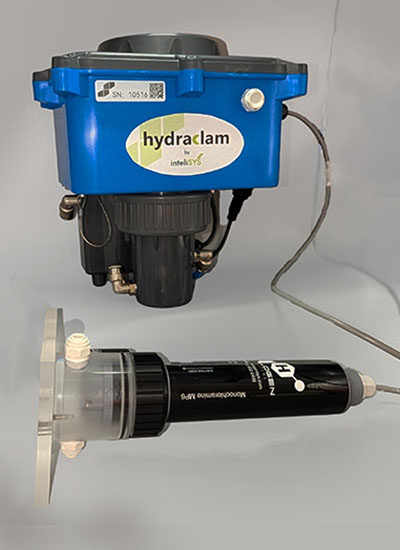
The HydraClam is a fully integrated drinking water quality monitoring device with built in datalogger and telemetry.

Hydraclam records multiple parameters at the same location to help teams investigate changes in distribution water quality. Comparing turbidity, conductivity, pressure and temperature, with disinfectant residual where fitted, provides context for baseline surveys, operational changes and mains interventions.

Features of all HydraClam models:

Parameter

Range

Accuracy

Resolution

Method

Turbidity

0.1 – 10 NTU

±5% of reading or ±0.1 NTU

0.05 NTU

Nephelometric

Conductivity

20 – 3500 µS/cm

±2% of range

1 µS/cm

4-pole

Pressure

0 – 10 bar absolute

±1.25% of full scale

0.1 bar

–

Alongside:

Temperature

approximately 2 kg

WIT device for local setup

Bi-directional 4G

210 × 210 × 210 mm max

internal antenna with external option

Logging and upload intervals programmable 1 minute to 12 hour

Threshold based upload triggers

6 mm hose connection with patented flushing control

up to 50,000 data points held on device

Choosing a configuration

Model

Cl Configuration

Also includes

Sample flow

Power

Suits

HC4

No Chlorine Sensor

–

Base (purge volume x logging frequency)

All options — internal cells, external battery, mains, or solar

Networks distributing without a residual, a separate Cl measuring solution is in place

HC4+Cl

Amperometric, Free or Total

-

6 l/hr continuous + Base

Conventional free-chlorine networks

HC4+H5

Halogen, free

pH

Base

External supply required: mains, external battery, or solar with cabinet

Where pH context is needed alongside residual. Low servicing option

HC4+H6

Halogen, Free, Monochloramine and Total

pH

As above in a Chloraminated network

HydraClam Multi-parameter Drinking Water Quality Monitoring Unit
HydraClam HC4
HydraClam Multi-parameter Drinking Water Quality Monitoring Unit
HydraClam HC4+Cl
HydraClam Multi-parameter Drinking Water Quality Monitoring Unit
HydraClam HC4+H5
HydraClam Multi-parameter Drinking Water Quality Monitoring Unit
HydraClam HC4+H6

Measurement performance in the field

Fresh water from the main
Before each measurement cycle, Hydraclam flushes its integrated measurement cell and sample path. Flushing settings are matched to the installation, including the connection length and available flow, to displace water that has stood in the sample line.
Controlled conditions for measurement
Following the flush, the valve closes and measurements are taken with the sample held under pressure. Maintaining pressure helps limit bubble formation associated with pressure release. A series of rapid turbidity readings is averaged to reduce short-term measurement noise.
Confidence throughout the monitoring programme
Commissioning checks, appropriate calibration and planned cleaning and servicing help maintain measurement quality over time. These are particularly important when interpreting small changes at the low turbidity levels normally found in drinking-water networks.
Reviewing turbidity, conductivity, temperature and pressure together, with disinfectant residual where fitted, provides context for investigating unusual behaviour and assessing the effects of operational changes or mains interventions.